
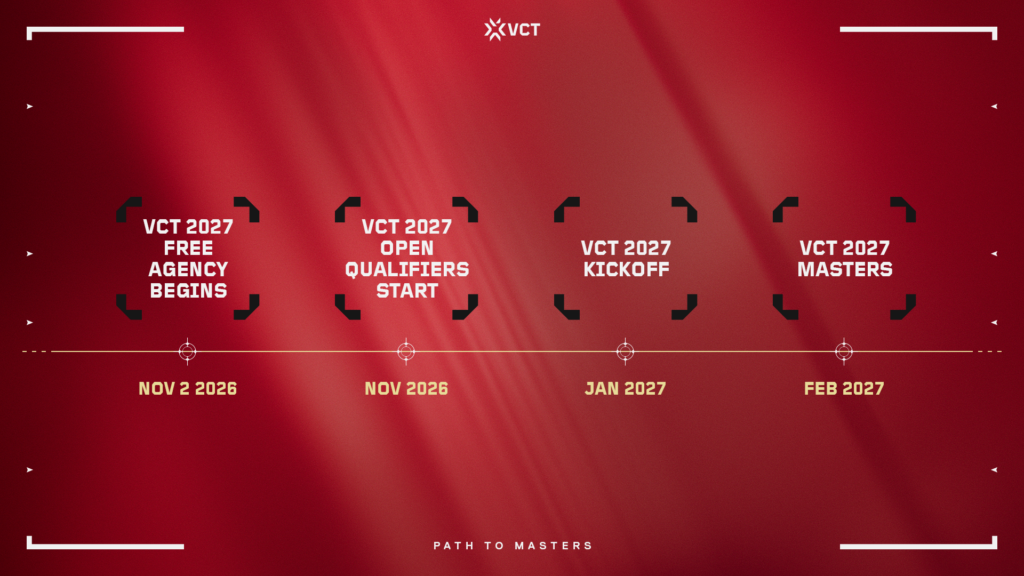
Riot Games published a competitive integrity framework for the VCT 2027 season on November 5, 2026, laying out anti-cheat requirements, eligibility thresholds, and broadcast rules for the new open qualifier path. The announcement covers every stage from Open Qualifiers through Open Playoffs and applies to any team hoping to reach the partner-tier circuit through competition rather than franchise slot.
A Three-Tier Integrity Framework
The framework scales protections across three stages of online competition, each adding a layer of oversight on top of the last.
In Open Qualifiers, the baseline is Vanguard-led protection combined with post-match reporting and retroactive enforcement. Riot described this as the entry point: automated detection handles the bulk of the work, and players or officials can flag suspicious matches for review after the fact.
Open Play-Ins raise the bar with what Riot calls an elevated baseline, giving regional organisers discretion to add monitoring tools as they see fit. The specifics of that discretion are left to each region’s tournament organiser.
Open Playoffs carry the full weight of the framework. Mandatory requirements at this stage include voice monitoring, player point-of-view recordings, match-area cameras, and additional anti-cheat checks beyond what Vanguard provides on its own. This is the stage where a team is closest to earning a spot alongside partner organisations, and Riot is treating it accordingly.
Tournament officials are authorised to conduct verification or integrity checks during a match at any stage. That authority includes reviewing player setups, requesting recordings, requiring teams to live stream their match area, or checking communications. Riot stated plainly: “Riot Games has a zero tolerance policy for cheating. Enabling or assisting others to cheat is also prohibited.”
Confirmed violations result in sanctions including disqualification and competitive suspensions, determined by tournament officials based on the violation, the evidence, and the applicable rules.
Eligibility: Rank, Account Standing, and Vanguard
Getting into Open Qualifiers is no longer a matter of simply registering a roster. Riot set three gates.
First, every competitor must have reached Ascendant rank or higher. Riot stated: “Players will need to be Ascendant+ to compete in Open Qualifiers.” This filters out accounts that exist solely to enter the bracket without a demonstrated skill baseline.
Second, each account must be in good standing. Riot defines that as an account that is not currently banned and has not received a Game Ban, Vanguard Intervention, Ranked Restriction, or Comms Restriction within the last 30 days. The account also must not be subject to a Ranked queue restriction during the enrollment or competition period. A player who picked up a comms restriction two weeks before qualifiers open is locked out until it expires.
Third, all competitors must be Vanguard Check compliant. The announcement does not publish a hardware specification list on the primary page, but the requirement means every machine used in competition must pass Riot’s pre-competition security verification. Players whose rigs run older hardware configurations or lack certain security features should verify compliance well before registration opens.
Broadcast Delays, Co-Streaming, and Coach Rules
Stream sniping has been a persistent concern in any open online bracket, and Riot addressed it directly. Player POV livestreams are required to carry a broadcast delay of at least two minutes. Teams that run their own multi-POV broadcasts must apply the same delay to each individual stream.
Third-party creators who want to co-stream a player’s POV feed must obtain approval from the tournament organiser before doing so. This closes the loophole where an unaffiliated streamer could relay a competitor’s perspective with little or no delay, effectively providing real-time information to opponents watching the broadcast.
Coach communication rules shift depending on the stage. In early rounds of online competition, coaches may communicate with players during matches. In later stages of Cup qualification tournaments, coach communication will be monitored and must follow the same rules that currently govern the VCT partner league. The transition point is not specified as a single match number but rather as a progression through the bracket.
What Changes for Players
- Check your rank history. If you have not hit Ascendant or above, you cannot enter Open Qualifiers. This is a hard requirement, not a recommendation.
- Audit your account standing. Any Game Ban, Vanguard Intervention, Ranked Restriction, or Comms Restriction received in the 30 days before enrollment or competition blocks eligibility. A comms ban from a toxic lobby in ranked counts.
- Verify Vanguard compliance early. Do not wait until the day before your first match. If your system does not pass Vanguard Check, you need time to resolve it—whether that means a BIOS update, a Windows version change, or a hardware swap.
- Set your stream delay. If you or your team plan to broadcast POV during Open Qualifiers, configure a minimum two-minute delay now and test it. The requirement applies to every stream, including multi-POV setups.
- Coordinators and coaches should note the stage-based rules. Coach comms are permitted early but monitored later. Plan practice and communication protocols with that transition in mind.
The restructured VCT 2027 format replaced the old league system with Cups and open qualifiers, meaning more teams than ever will pass through these online stages. The integrity framework exists because the stakes at each tier are now real: a deep run in Open Qualifiers feeds directly into the path toward partner-tier competition. Riot is betting that layered enforcement—automated detection at the bottom, human oversight and cameras at the top—can keep that path credible without requiring every entrant to fly to a LAN. Whether it holds up under the volume of an open bracket remains to be seen, but the requirements are now on the record.