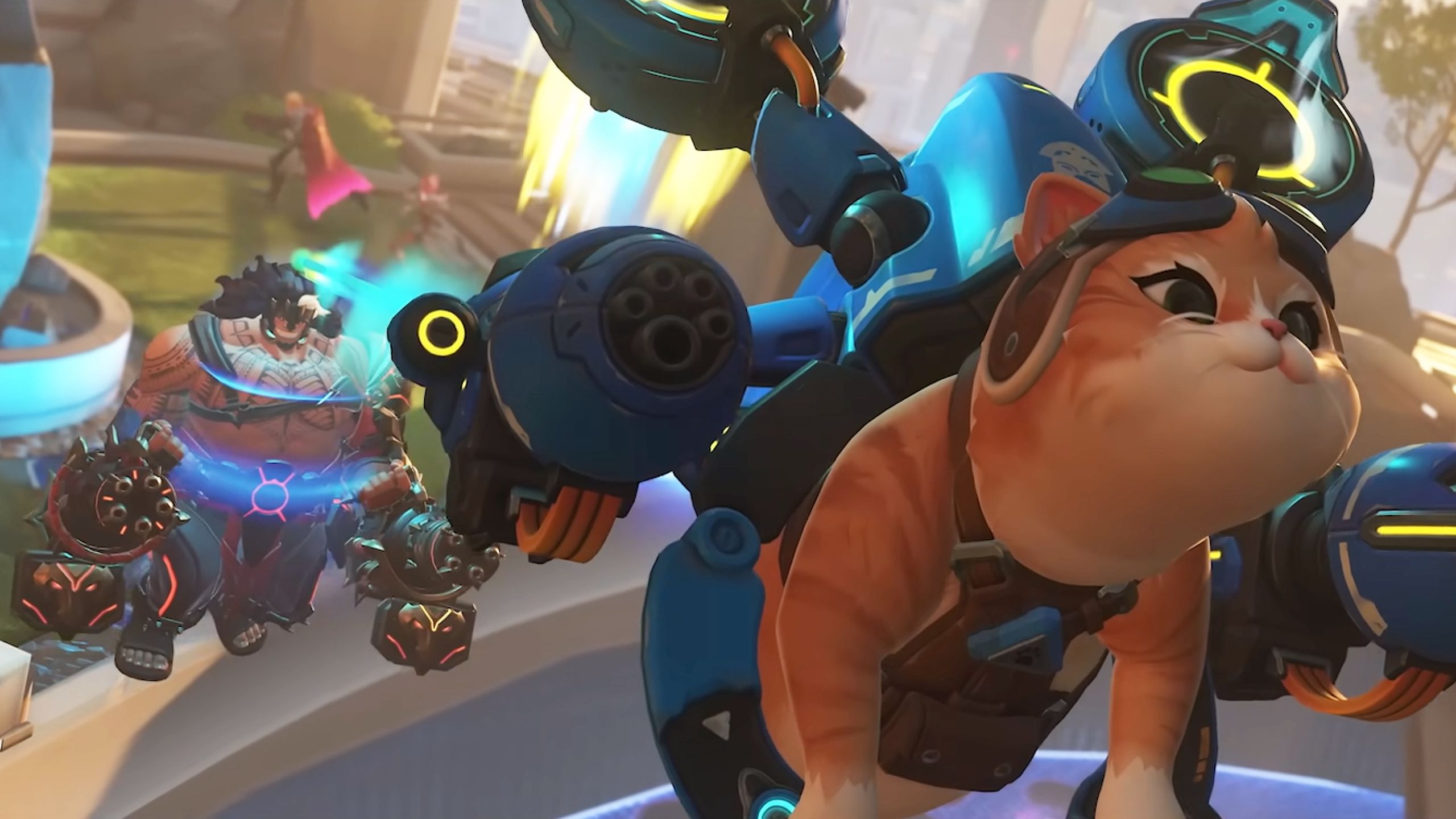
When Team 4 launched its restructured version of Overwatch nearly a year ago, five new heroes arrived alongside a revamped seasonal cadence. One of them, Jetpack Cat, immediately broke the competitive meta by carrying Bastion into the air in turret mode and letting him gun down entire teams from above. The development team knew this was coming. Associate Game Director Alec Dawson told PC Gamer that internal playtesting flagged the interaction as alarming, and that the team made a deliberate choice to let it ship un-nerfed.
The Apache Helicopter Meta
The combo was straightforward: Jetpack Cat grabs Bastion, flies him high above the map, and Bastion activates turret mode. From that altitude, Bastion’s hitscan spread covers enough ground to shred grouped teams before they can react. The community quickly dubbed it the “Apache helicopter meta,” and it was not a joke. The combo dominated the Overwatch Champions Series from the start of the season.
Dawson recalled the internal reaction during testing: “Internally we were like, ‘oh, that’s a little scary.'” The situation got worse when a third hero entered the picture. “I think at one point it was also Jetpack Cat, Bastion, and Mercy. The full trio. It’s like an even scarier helicopter,” Dawson said.
The trio version added Mercy’s damage boost to the equation, turning an already oppressive carry into something that could delete full teams in seconds. That variant never became the dominant competitive pick, but its existence in testing shows how far the interaction could scale before the team intervened.
For context on how quickly this took over: five new heroes launched alongside Jetpack Cat—Mizuki, Emre, Anran, Domina, and Jetpack Cat herself—yet it was the ginger cat in the flying mech that defined the meta almost immediately. No other new hero at launch came close to that level of competitive adoption in the same timeframe.
Why Team 4 Shipped It Anyway
The decision to let the combo go live was not an oversight. Dawson described it as a calculated trade-off between competitive health and the kind of memorable moments that keep players engaged.
“We want to make sure we put some of those moments in front of players. Allow them to experience a little bit of that crazy stuff before we come in and try to make sure it’s in line, right? It’s really that fine line of not taking away all the fun, not diluting it, not trying to take away some of the extremes, and seeing how it actually plays out. Because those are the moments that are going to be really exciting for players, those are going to be the moments that they remember in Overwatch, and that’s important not to whittle away too early.”
That philosophy is not new to Blizzard’s balance team, but it carries risk. The OWCS is a professional circuit with real stakes, and a dominant combo that persists across multiple weeks can warp an entire stage of competition. Teams that built around the carry had a structural advantage over those that did not, regardless of individual skill. The meta did not self-correct; it required a patch.
Dawson’s framing treats the overshoot as a feature rather than a bug—a window of chaos that generates excitement and clips before the tuning pass arrives. Whether that trade-off is worth it for players grinding ranked during the dominant stretch is a separate question, and one the fact sheet does not address from the player side.
The Nerf and What Remains
The fix, when it came, targeted the core mechanic that made the combo oppressive: Jetpack Cat’s movement speed while carrying another hero was reduced. The nerf landed with Season 3, after the Apache helicopter meta had already run through the World Cup portion of the competitive calendar.
The reduction in carry speed means Bastion spends more time in transit and is easier to contest before reaching optimal altitude. It does not remove the interaction entirely. Jetpack Cat can still carry Bastion, and the combo still exists in a weakened form. The patch notes describe it as a speed adjustment, not a removal of the carry mechanic itself.
Even post-nerf, Jetpack Cat remains a difficult hero to deal with in practice. Her mobility kit and the residual threat of the carry keep her relevant in compositions that want vertical pressure. The nerf narrowed the window of dominance; it did not close it.
This pattern—ship strong, observe, then tune—is consistent with how Team 4 has handled other balance interventions this year. The cadence of yearly themes across several seasons means each patch window is an opportunity to adjust, and the team appears willing to let things run hot before pulling back.
What This Means for Players
If you are playing ranked right now, the Jetpack Cat and Bastion combo is still a viable pick, just less oppressive than at launch. The carry speed reduction means you have more time to contest the ascent, and dive compositions that can reach Jetpack Cat before she reaches altitude are the most direct counter.
- Against the combo: Prioritize killing Jetpack Cat during the carry, not Bastion after he is deployed. Hitscan heroes and dive tanks that can reach her mid-flight are the strongest answers. Mercy’s resurrection does not save a Bastion who is dropped from height.
- Running the combo: The nerf means you need more setup time and better positioning before the carry begins. Launching from a protected angle rather than open ground gives the carry a higher success rate post-patch.
- Hero pool impact: Jetpack Cat is still worth learning. Her kit extends beyond the Bastion carry, and her mobility makes her a flexible pick in non-carry compositions. The nerf reduced one interaction, not her entire kit.
The broader takeaway from Dawson’s comments is that Team 4 is comfortable letting new heroes overshoot at launch. If you are theorycrafting around future hero releases, expect a similar pattern: a window of dominance, followed by a tuning pass once competitive data confirms the problem. Planning around that window—either to exploit it or to counter it—is part of the current meta cycle.