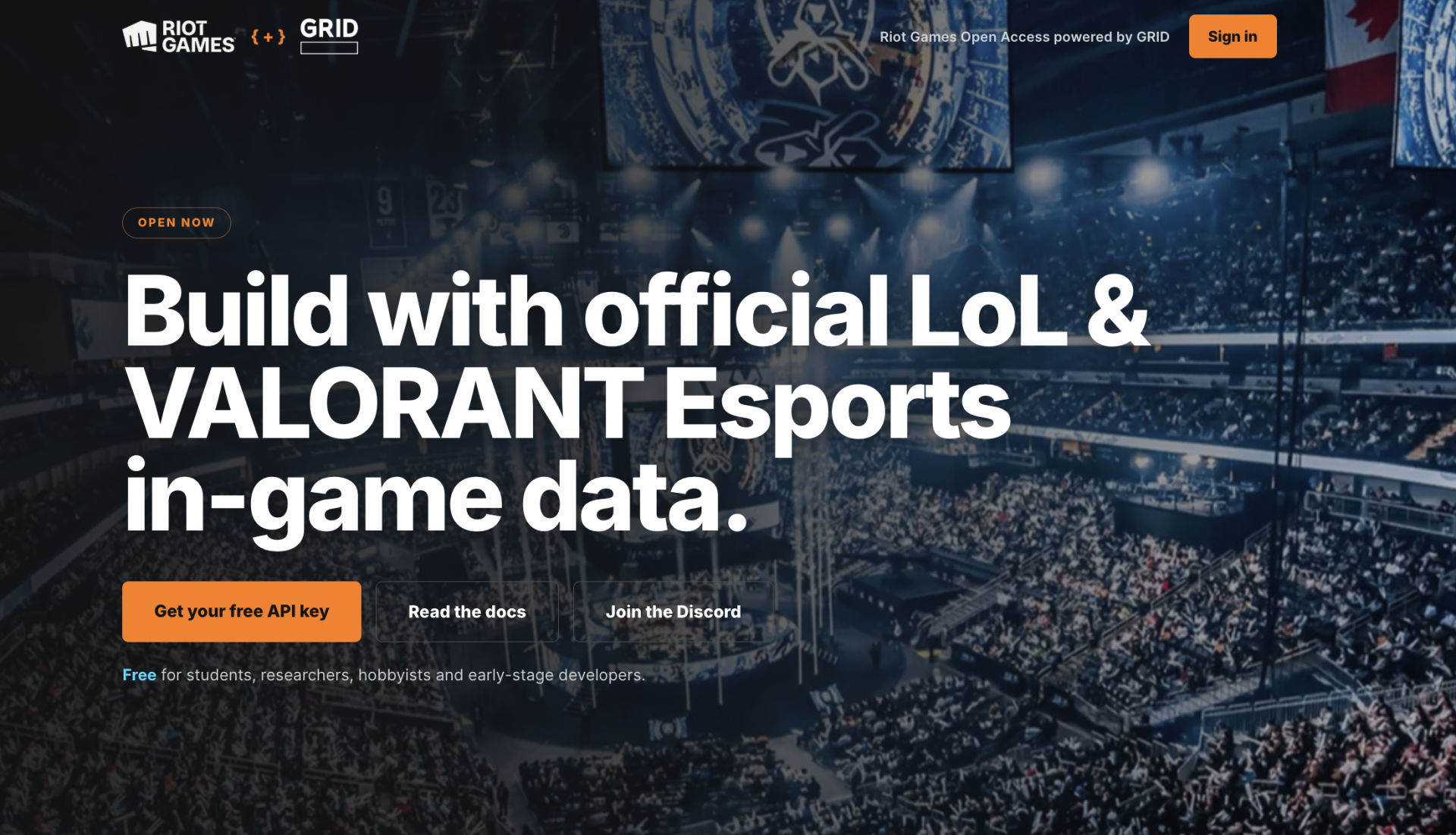
Starting November 14, 2026, Riot Games opened official League of Legends Esports data to the public through a new self-serve portal called Riot Games Open Access, powered by data partner GRID. The portal gives students, researchers, hobbyists, and early-stage developers free access to match data that was previously available only through commercial agreements. Worlds 2026 is the first event covered, with both League of Legends and VALORANT Esports data included from the start.
What the Portal Includes
Riot Games Open Access provides two primary data products: the Central Data Feed and the Series State API, which includes Loopfeed. The Central Data Feed delivers granular match data — the kind of information that powers post-game stat pages, draft analysis tools, and performance dashboards. The Series State API tracks the status of ongoing series, letting developers build features that know whether a match is live, paused, or completed without scraping unofficial sources.
The scope is worth noting. This is the same data pipeline that GRID has supplied to professional teams and tournament operators since becoming Riot Games’ official esports data partner in 2023. GRID provides data across both the LoL and VALORANT Esports ecosystems to support competitive integrity — meaning the underlying feed is the one teams already use for scouting and preparation. The difference now is access: anyone with an account can pull from it, rather than needing a commercial contract or a team credential.
Worlds 2026 serves as the launch event. The fact sheet’s page summary references “Worlds Final data” while the article body states “Worlds 2026 will be the first event available,” so the exact scope — whether the full tournament or only the grand final — is not entirely clarified in the announcement. What is clear is that the data begins with the most recent major event and will presumably expand to cover future tournaments.
How Access Works
The process is deliberately low-friction. Users create an account on the Riot Games Open Access portal hosted by GRID, generate a personal API key, and consult the provided documentation to begin making requests. There is no application process or approval queue — the portal is open to anyone who fits the stated audience of students, researchers, hobbyists, and early-stage developers.
One important constraint: live series data carries a five-minute delay. This is a deliberate design choice. A real-time feed of official esports data, freely available to anyone, would create obvious integrity risks — from real-time betting exploitation to in-game information leakage. The five-minute buffer means that by the time data arrives through the public API, the relevant game state has already been broadcast and resolved. For developers building post-match analysis tools, draft recap pages, or historical stat databases, the delay is irrelevant. For anyone hoping to build a real-time overlay during a live broadcast, this portal will not serve that purpose.
The inclusion of both LoL and VALORANT data under one roof is notable. Developers interested in cross-title esports analytics — comparing viewership patterns, tournament structures, or meta evolution across Riot’s two biggest competitive titles — can do so from a single API key.
Why This Matters for the Ecosystem
Before this launch, official esports match data was gated behind commercial agreements. Third-party stat sites either negotiated data deals with Riot or GRID directly, or relied on unofficial scraping methods that broke frequently and carried no accuracy guarantee. Independent developers and academic researchers had no legitimate path to the same data that professional teams received.
Opening the feed changes that calculus. A student writing a thesis on draft theory can now pull the same pick-and-ban data that a Worlds semifinalist’s coaching staff uses. A hobbyist building a community stat tracker no longer needs to reverse-engineer an API or hope a scraper stays functional between patches. An early-stage startup can prototype a product on real data before approaching Riot or GRID for a commercial tier.
The timing is also relevant. Worlds 2026 just concluded — Bilibili Gaming defeated Gen.G 3-1 in the final — so the data set is fresh and top-of-mind for the community. Making it available immediately after the event gives developers a concrete, high-profile data set to build against, which is more useful than launching with a stale archive.
GRID’s role here is worth a sentence. The company has been Riot’s official esports data partner since 2023 and already handles data distribution to teams for competitive integrity purposes. Open Access extends that infrastructure to a wider audience without requiring Riot to build a separate data platform. It is, effectively, GRID doing what it already does but with the commercial gate removed for non-commercial users.
For Players
This announcement does not change anything about how League of Legends plays. No patch, no balance adjustment, no ranked system tweak. The impact on competitive players is indirect but real: better third-party tools mean better analysis of professional play, and better analysis trickles down into how the broader community understands drafts, itemization trends, and macro play.
If you follow the pro scene and have ever wanted to dig into why a certain team’s draft worked or compare a player’s performance across tournaments, the tools that answer those questions just got easier to build. The people who will build them are the ones this portal targets. For everyone else, the benefit arrives later, in the form of sharper stat pages, more detailed broadcast overlays, and community projects that previously had no reliable data source.
The five-minute delay means nothing here changes during a live match. What changes is everything after the match ends.