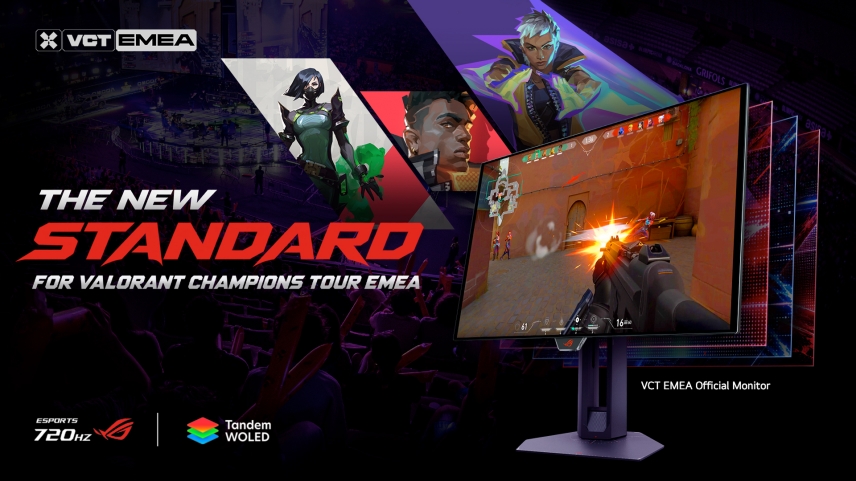
LG Display has become an official partner of VALORANT Esports EMEA for the 2027–2028 season, supplying its 24.5-inch FHD 720Hz Tandem WOLED panels as the competition monitors for both VCT EMEA and Game Changers EMEA. The partnership was announced by VALORANT Esports Staff on 24 November 2026.
The monitors will be deployed at the Riot Games Arena in Berlin for regular-season play and will travel to Warsaw and Istanbul for the 2027 Cup Finals. Riot Games framed the deal as part of a broader reset for the league, noting that 2027 marks the beginning of a new era for VCT.
What Tandem WOLED actually brings to the stage
The headline specification is the 720Hz refresh rate on a 24.5-inch FHD panel, which LG Display describes as the world’s fastest Tandem WOLED display built specifically for esports. In practical terms, that refresh rate means the screen redraws more than twice as often as the 360Hz panels that have been common in professional FPS settings, potentially reducing perceived motion blur during fast flicks and tracking.
Beyond raw speed, LG Display highlights three properties of the Tandem WOLED panel that matter in an arena environment: high brightness, vivid colour reproduction and strong HDR performance. The panels also carry a low-reflection coating designed to minimise glare under stage lighting, a persistent complaint from players who have competed under arena spotlights on older matte or glossy panels.
Hyeon-woo Lee, Head of the Medium and Large Display Business Unit at LG Display, said the panel was tailored for the specific visual demands of competitive FPS play.
We are delighted with this opportunity to showcase the advantages of our panel, which is the world’s fastest Tandem WOLED display tailored specifically for esports. By providing exceptional clarity and smoothness, it can clearly capture even fast-paced moments such as the flash of a gun muzzle, making it a highly immersive window into the world.
That claim about muzzle-flash readability is worth noting. In VALORANT, the brief flash of a Vandal or Phantom shot can reveal an enemy’s position through smoke or around a corner. If the panel genuinely renders those frames more distinctly than a lower-refresh-rate display, it is a tangible competitive advantage, not just a spec-sheet number.
Where the monitors will appear
The deployment covers three distinct settings across the 2027 calendar:
- Riot Games Arena, Berlin – the permanent home of VCT EMEA league play, where both VCT EMEA and Game Changers EMEA matches will take place on the new panels.
- Cup Finals in Warsaw – one of the two off-site events scheduled for 2027.
- Cup Finals in Istanbul – the second travelling event for the season.
Charlie Allen, EMEA Director of Commercial Partnerships & Business Development at Riot Games, said the partnership was driven by player-performance requirements rather than branding alone.
We are excited to partner with LG Display for the upcoming season and have their powerful technology used on stage at the Berlin arena, and when we take the competition on the road to Warsaw and Istanbul. VALORANT players need certain qualities from their monitors to perform at their best: fast response times, high-quality display performance and, of course, clear visibility when competing under the bright lights of an arena. This partnership will ensure the players can always compete at their fullest potential.
The inclusion of Game Changers EMEA in the deal means the women’s circuit will use identical hardware to the main VCT EMEA league, removing any equipment disparity between the two competitions.
What this means for players
For the professionals stepping onto the Berlin stage in early 2027, the most immediate adjustment will be the jump in refresh rate. Players who have practised exclusively on 240Hz or 360Hz monitors may notice a difference in how motion appears during flicks and micro-adjustments. The higher frame clarity at 720Hz can make tracking feel smoother, but it can also make small aiming errors more visible, which some players find initially unsettling.
The low-reflection coating is the other change worth watching. Arena lighting has historically washed out colours and introduced glare on standard esports monitors, forcing players to compensate with brightness settings or visor adjustments. If the coating performs as advertised, it removes one variable that players previously had to manage during a match.
For ranked players at home, the direct takeaway is simpler: this partnership signals where monitor technology for competitive FPS is heading. A 720Hz OLED panel is not yet available at retail, but the specification sets a benchmark that consumer panels will chase over the next year or two. Anyone currently shopping for a competitive monitor should be aware that the ceiling is moving higher, even if the price of admission remains steep for the foreseeable future.