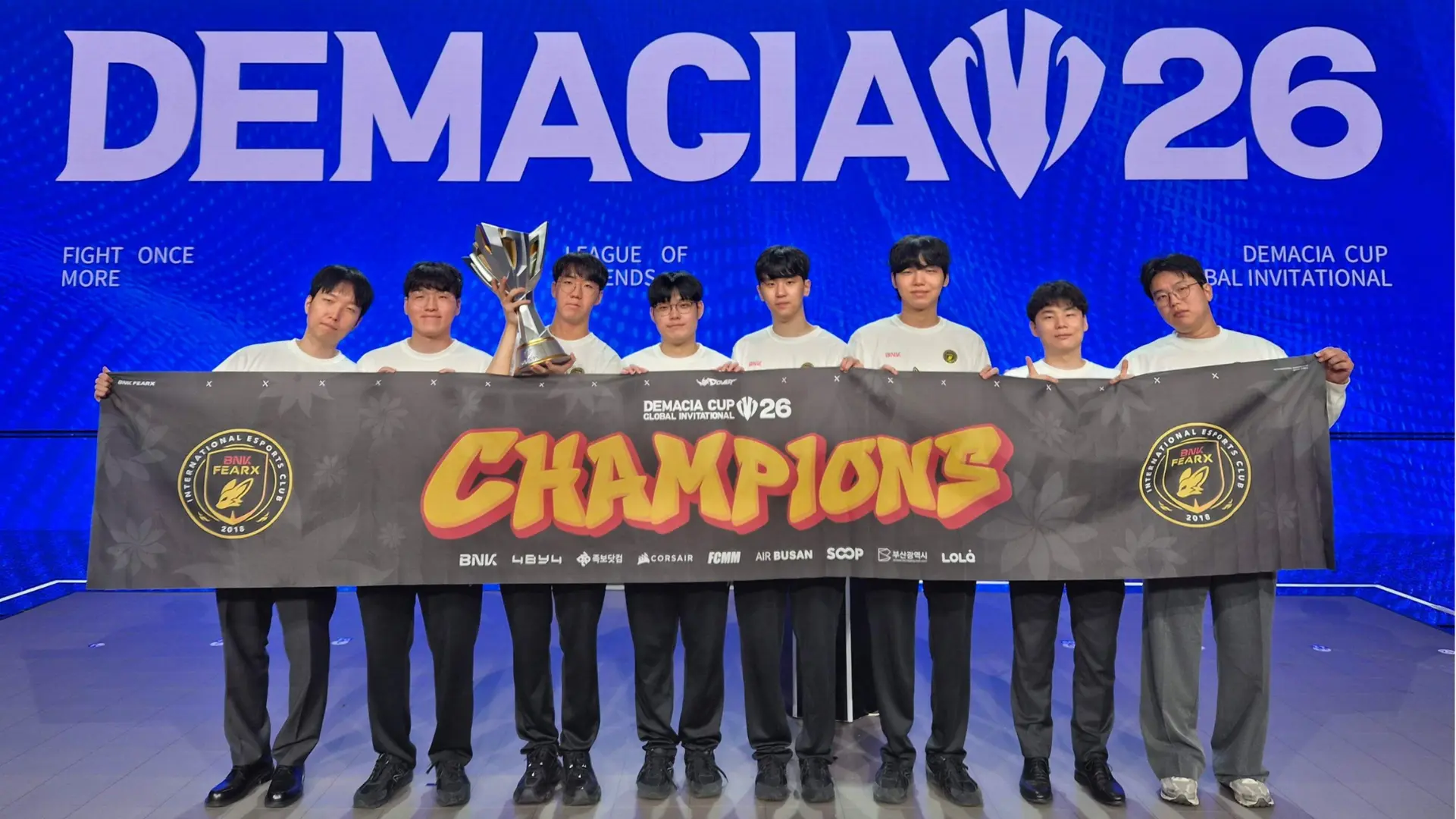
BNK FEARX defeated Team WE 3-1 in Beijing on 17 October 2026 to win the inaugural Demacia Cup Global Invitational. Jungler Jeon “Raptor” Eo-jin was named Finals MVP after a series-defining performance, and the Korean organisation took home CNY600,000 from a total prize pool of CNY1,500,000. BNK FEARX announced the title on their official account shortly after the final game concluded.
A lopsided start, a brief answer
The series opened with a statement. In game one, Raptor’s Lee Sin posted an 11/2/6 scoreline as FEARX rolled to a 24-8 kill advantage over 31 minutes and 23 seconds. The result was never genuinely in question during that opening game; WE had no answer for the pressure Raptor applied across the map, and the kill gap reflected a systemic failure to match FEARX’s tempo rather than a single misstep.
FEARX carried that momentum into game two and took a 2-0 lead, putting Team WE on the brink of a reverse sweep. The Chinese side, however, refused to go quietly. In game three, Karis on LeBlanc and Monki on Wukong found enough picks on the enemy ADC to swing the game WE’s way, preventing the sweep and giving the home crowd something to cheer. It was the kind of game that can shift momentum in a best-of-five—a lifeline that, historically, has turned series around.
It did not happen here. FEARX reset in game four and closed the series without letting WE force a decider. ADC Kim “Taeyoon” Tae-yoon delivered an 8/1/5 performance in that final game, a clean line that underscored his composure when the series was still technically alive. The game never reached the tension of a true game five, and FEARX sealed the title with the kind of controlled aggression that had defined their game one.
Raptor’s Finals MVP award was not a close call. His 21-kill total across the series made him the obvious candidate, and his game-one Lee Sin performance set a tone that WE never fully recovered from. For a jungler to dominate a best-of-five to this degree is notable in any context; doing it on the road in Beijing against a team with home-crowd support makes it a more impressive showing.
What the result means for both teams
For BNK FEARX, the Demacia Cup Global Invitational title adds another international trophy to the cabinet. The organisation, which represents Busan and carries the BNK sponsorship, has built a reputation as a consistent performer on the global stage. This win in the inaugural edition of a new Riot Games-sanctioned event gives them a place in the tournament’s history that no one can take away, regardless of how the event evolves in future years.
The Demacia Cup Global Invitational itself is worth noting as a format. The inaugural edition featured a Swiss stage and brought together teams from multiple regions, with participants including Team Vitality, LGD Gaming, JD Gaming, KT Rolster, FlyQuest, BRION and Dplus KIA alongside the two finalists. That FEARX navigated this field and peaked in the final speaks to their preparation and adaptability against varied regional styles.
For Team WE, second place represents their strongest international result in recent years. That framing is doing some heavy lifting—WE are one of the oldest and most storied organisations in Chinese League of Legends, and a runner-up finish at a new invitational is not the kind of headline their fanbase would have dreamed of a decade ago. But context matters: the team is locked out of Worlds 2026, which means this tournament was their last chance to compete on an international stage this season. A silver medal in that situation is a consolation prize, not a breakthrough.
The game-three win showed that WE can still find winning lines against top Korean opposition when their draft hits and their players execute. Karis and Monki’s coordination in that game was sharp. The problem is consistency across a full series, and that gap between one good game and four good games is what separates a team that qualifies for Worlds from one that watches from home.
For players
If you follow the competitive scene to inform your own play, the takeaway from this series is straightforward: jungle pressure that denies the enemy team’s carry from scaling remains the most reliable win condition at the highest level. Raptor’s Lee Sin performance in game one was not a showcase of mechanical outplays so much as a masterclass in timing and map presence—he was everywhere WE needed him not to be, and the 24-8 kill score was the downstream result.
For ranked players, the lesson is less about copying Lee Sin picks and more about understanding tempo. FEARX won because their jungler dictated the pace from the first objective onward, and WE never found a window to stabilise. If you are jungling in solo queue, the principle translates: early pressure that forces the enemy to react, rather than letting them farm comfortably, compounds into advantages that are very difficult to reverse in a coordinated game.
The Demacia Cup Global Invitational also confirmed that the gap between top Korean and Chinese teams remains narrow enough that a single good game can swing a series. WE’s game-three win was proof of that. For players watching to understand the current meta at the pro level, the series reinforced that draft flexibility and targeted picks against the enemy carry are still the great equalisers when raw mechanical skill is roughly matched.